CBT-I
How does CBT-I work?
CBT-I doesn't target the symptoms: it works on the mechanisms that keep insomnia going. Eight specific techniques, grounded in the 3P model, to rebuild deep, lasting sleep.
Key points
- In chronic insomnia, the original trigger has often gone: it is the perpetuating factors that keep the problem going, and that is what CBT-I works on.
- Sleep restriction and stimulus control are the behavioural core of the treatment.
- Cognitive restructuring is the most powerful component (iOR: 1.68).
The 3P model: why insomnia becomes chronic
The theory CBT-I is built on is Spielman's 3P model, the standard framework worldwide for understanding how a bad night turns into chronic insomnia.
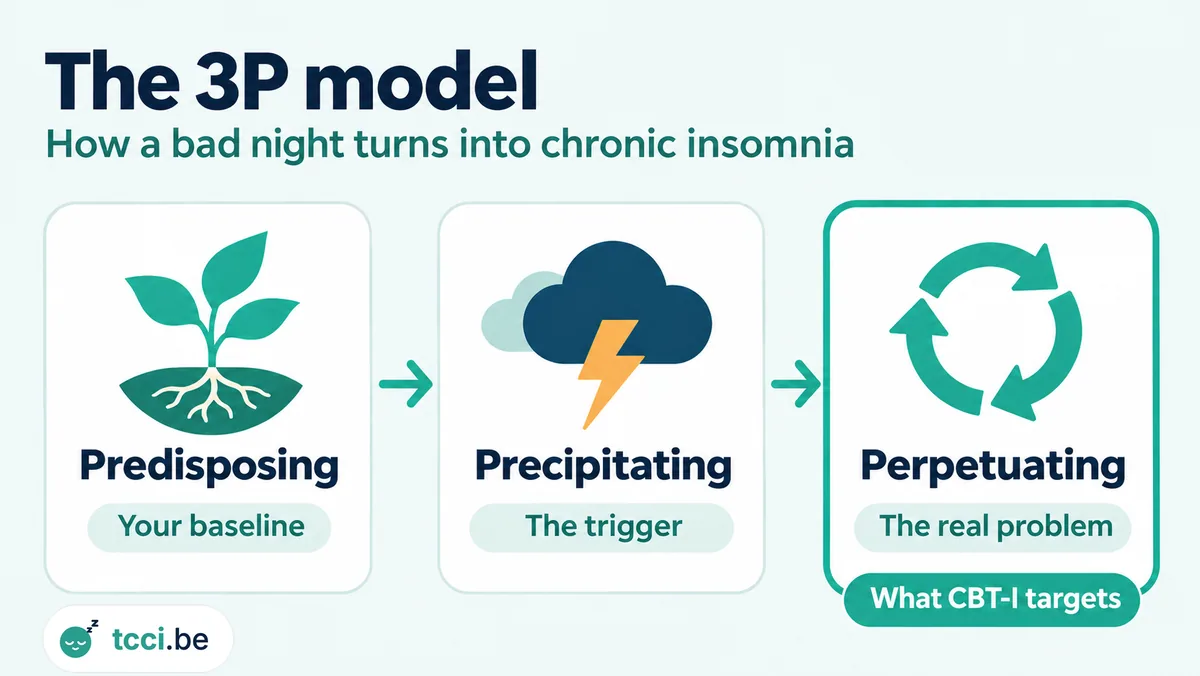
P1
Predisposing
Your baseline
Your underlying vulnerability, which stays fairly stable: a tendency to anxiety, physiological hyperarousal, genetics. Usually not something you can change.
P2
Precipitating
The trigger
Divorce, overwork, bereavement, illness, a new baby... They push you past your tolerance threshold. Often temporary, but they leave the door open to the perpetuating factors.
P3
Perpetuating
The real problem
Unhelpful habits and beliefs you develop to cope with insomnia, which end up keeping it going. The main target of CBT-I.
The core principle
In chronic insomnia, the original trigger has often gone. It is the perpetuating factors alone that keep the problem alive. So the aim of CBT-I is to change those perpetuating factors.
The vicious circle of insomnia
Chronic insomnia keeps itself going through 4 components that reinforce one another:
Arousal
Emotional, mental and physical. Anxiety, racing thoughts, muscle tension at bedtime: the starting point of the circle.
Unhelpful habits
Staying in bed longer, napping, taking sleeping pills. They help in the short term and make things worse in the long run.
Unhelpful beliefs
"I need 8 hours of sleep", "Without sleep I won't be able to cope". These beliefs fuel performance anxiety, the worst enemy of sleep.
Consequences
Tiredness, irritability, not performing as well. These consequences are real, though often magnified, and they feed the worry in turn.
The most insidious component
Performance anxiety. Trying to sleep is the worst thing you can do. The harder you try to force sleep, the further it slips away, just like a name that's on the tip of your tongue.
The 8 techniques of CBT-I
The CBT-I protocol is built around 8 complementary techniques. The first two, sleep restriction and stimulus control, are the behavioural core of the treatment.
- 1. Sleep restriction
- 2. Stimulus control
- 3. Fixed wake-up time
- 4. No naps
- 5. Wind-down time
- 6. Bedtime routine
- 7. No clock-watching
- 8. Sleep hygiene
- In bed, asleep
- In bed, awake
1. Sleep restriction
The key technique, and the most counter-intuitive
The idea is to keep the time you spend in bed as close as possible to the time you actually sleep. If you spend 9 hours in bed but only sleep for five and a half, your sleep is spread thin. Restriction concentrates it.
How to work out your sleep window
- 1 Work out how much you actually slept on average over the past week (from your sleep diary)
- 2 That is your sleep window, with a minimum of 5 hours to avoid excessive sleepiness
- 3 Choose a fixed wake-up time, then count back to find your bedtime
A worked example
You spend 9 hours in bed but only sleep 5½ hours → sleep window = 5½ hours, so you go to bed at 00:30 and get up at 06:00.
Weekly adjustment based on sleep efficiency
| Sleep efficiency | What to do |
|---|---|
| Below 80% | Shorten the window by 15-20 minutes |
| 80% to 85% | Keep the window the same |
| Above 85% | Lengthen the window by 15-20 minutes |
Feeling sleepy during the day at the start is normal. It is a sign that sleep pressure is building, and that you will fall asleep faster and sleep more deeply over the next few nights.
Effectiveness: iOR 1.49, one of the most powerful components of CBT-I (Furukawa, JAMA Psychiatry 2024).
2. Stimulus control
Retraining the brain to link bed with sleep
After many nights lying awake and ruminating, the brain comes to link "bed" with "awake and anxious" rather than with "sleep". Stimulus control aims to break this reversed conditioning.
Only go to bed when you feel sleepy
Not tired: sleepy. The difference matters: heavy eyelids, yawning, blurred vision. Tiredness is a subjective feeling of exhaustion, not a signal that sleep is on its way.
If you are not asleep within 15-20 minutes, get up
Go to another room and do something calm (reading, a crossword). Avoid screens, exercise and anything stimulating. Only go back to bed when the sleepiness returns.
Keep the bed for sleep and intimacy
No reading, no TV, no phone, no work in the bedroom. This rule is strict, and it is fundamental.
Don't check the time during the night
This is a major trap. Clock-watching feeds performance anxiety and keeps your mind switched on.
Effectiveness: iOR 1.43, a key behavioural component (Furukawa, JAMA Psychiatry 2024).
The 6 other techniques
3. Fixed wake-up time
Set an alarm and get up at the same time every morning, weekends and bank holidays included, however the night went.
Catching up on sleep at the weekend is particularly harmful: it throws your body clock out of sync and lowers sleep pressure at the most critical moment, on Sunday night.
Practical tip: Put your alarm out of reach of the bed, so you have to get up to switch it off.
4. No naps
Naps use up the sleep pressure built up during the day, which makes it harder to fall asleep at night.
The rule is simple: the longer you stay awake during the day, the faster sleep will come in the evening.
5. Wind-down time before bed
Give yourself at least an hour to unwind before bedtime, outside the bedroom. Light reading, music, conversation.
Try not to go over the day's events or plan the next day. If worries start crowding in, write them down on paper and set them aside until tomorrow.
6. Bedtime routine
Follow the same routine every evening at the same time (washing, changing for bed, a few quiet minutes).
Repeating the routine gradually teaches the brain to link this sequence with falling asleep, much like a child who drifts off to the same lullaby every night.
7. Don't watch the clock
Turn your alarm clock around or cover it. Checking the time at night feeds performance anxiety.
"I've only got three and a half hours left, I'll be wrecked tomorrow": this kind of thought keeps your mind switched on at exactly the moment you want it to switch off.
8. Sleep hygiene
Sleep hygiene rules (caffeine, alcohol, exercise, bedroom environment) are an essential foundation, but on their own they are not enough for chronic insomnia.
On its own, sleep hygiene has only a marginal effect (iOR: 1.01, JAMA Psychiatry 2024). It is combining it with the other techniques that makes all the difference.
Cognitive restructuring: changing your beliefs about sleep
People with insomnia often develop automatic, repetitive, catastrophising beliefs. These thoughts have things in common: they pop up on their own, feel true in the moment, are usually exaggerated, and keep the problem going rather than helping.
Common automatic thoughts
- "If I don't get 8 hours, I won't be able to function tomorrow."
- "My insomnia is going to ruin my health in the end."
- "There's nothing I can do: my insomnia comes from a chemical imbalance."
The 4 most common cognitive distortions
Unrealistic expectations
Automatic thought
"I need exactly 8 hours."
Reality
Sleep needs vary from 5 to 10 hours from one person to the next. Different sleep is not abnormal sleep.
Exaggerating the consequences
Automatic thought
"I won't be able to do anything tomorrow."
Reality
Objective studies show that people with insomnia perform much better than they think. It is motivation that drops, not actual ability.
Blaming everything on insomnia
Automatic thought
"Everything is going wrong because of my insomnia."
Reality
Other factors play a part in your difficulties. Blaming it all on insomnia raises the pressure to sleep well the next night.
All-or-nothing thinking
Automatic thought
"If I don't fall asleep quickly, the night will be a disaster."
Reality
Sleep quality varies enormously from one night to the next, and you recover quickly from a bad night.
Restructuring in 3 steps
01
Identify
The automatic thought, put into precise words: "I absolutely have to sleep tonight."
02
Evaluate
How true it really is, using facts: "Have I really always been unable to function after a bad night?"
03
Replace
With a realistic alternative: "A bad night is unpleasant but manageable. My body will rebalance itself naturally."
The aim is not forced positivity
It is a realistic, evidence-based view of sleep. Like a researcher looking calmly at their data: no catastrophising, and no denial.
Effectiveness: iOR 1.68, the most powerful component of CBT-I (Furukawa, JAMA Psychiatry 2024). One-to-one, face-to-face therapy reaches an iOR of 1.83.
Why it works where medication fails
Sleeping pills act on the symptoms without changing the underlying mechanisms. When you stop, the insomnia comes back, often with a rebound effect. Dependence builds up gradually.
50-60%
remission at 6-12 months (Perlis, Lancet 2022)
41%
long-term remission vs 28% with medication (Furukawa, PCN 2024)
24+ months
of benefits maintained after the programme ends (Perlis, Lancet 2022)
The key principle
CBT-I doesn't target the symptoms: it works on the mechanisms that keep insomnia going. Sleep restriction rebuilds homeostatic sleep pressure. Stimulus control restores the link between bed and sleep. Cognitive restructuring defuses catastrophic thoughts. Together, these three techniques deliver lasting results where medication fails in the long run.
Frequently asked questions
Was this page useful?
Scientific sources
- Spielman AJ, et al. A behavioral perspective on insomnia treatment. Psychiatr Clin North Am. 1987;10(4):541-553.
- Morin CM, Buysse DJ. Management of Insomnia. NEJM. 2024;391(3):247-258.
- Furukawa Y, et al. Components of CBT-I and their incremental odds ratios. JAMA Psychiatry. 2024;81(4):357-365.
- Furukawa Y, et al. Long-term remission of insomnia: CBT-I vs pharmacotherapy. Psychol Med (PCN). 2024.
- Perlis ML, et al. Insomnia - long-term efficacy of CBT-I at 24 months. Lancet. 2022;400:1047-1060.
- Harvey AG, et al. Sleep disturbance and cognitive function in insomnia. Psychol Med. 2002;32(4):623-632.