Insomnia
Causes of insomnia: why you're sleeping badly
Stress, screens, alcohol, age, the menopause, medication: insomnia has many possible causes. Pinpoint what is disrupting your sleep so you can tackle it effectively.
Key points
- A trigger brings on a run of bad nights, then the things you do to compensate keep the problem going.
- Even if you cannot change the trigger, you can work on the factors that keep insomnia going.
- If your insomnia is recent and has no obvious explanation, see your doctor to rule out a medical cause.
Spielman's 3P model
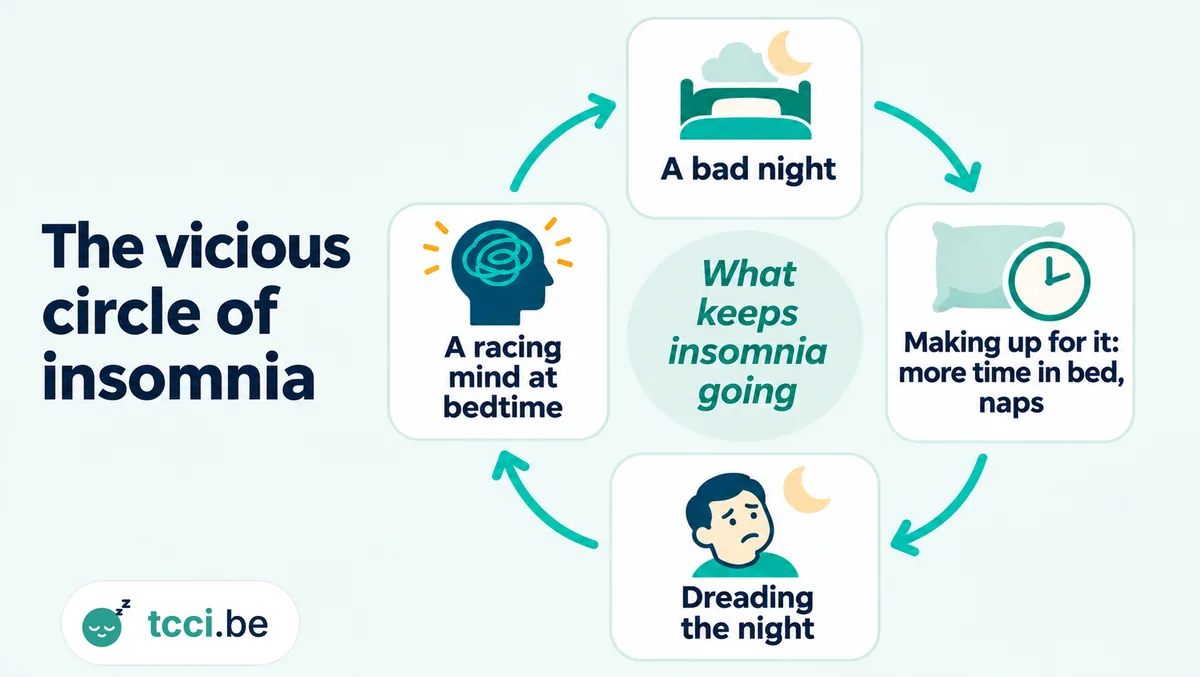
Chronic insomnia rarely follows a simple cause-and-effect pattern. In most cases, a trigger (stress, illness, a major life event) brings on a spell of difficult nights. Then compensating behaviours (staying in bed longer, napping, taking a sleeping pill) keep the problem going long after the original cause has gone.
Predisposing factors
Your personal make-up: genetics, an anxious temperament, a brain that is easily overactive. They raise your natural vulnerability to insomnia.
Precipitating factors
The trigger: a bereavement, losing your job, an illness, the birth of a child. They set off the first difficult nights.
Perpetuating factors
The habits that keep insomnia going: lying awake in bed, napping, irregular hours. These are exactly what CBT-I works on.
Remember
Even if you cannot change the trigger, you can act on the perpetuating factors. That is exactly what CBT-I does.
Stress and anxiety
This is the number one cause reported by people with insomnia. Chronic stress raises cortisol levels in the evening. This hormone releases energy at the wrong moment and keeps the brain on high alert.
What actually happens
- You go to bed tired, but your mind starts racing
- Your thoughts go round in circles (work, health, money, tomorrow…)
- The harder you try to sleep, the more awake you feel
- Worrying about not sleeping piles on top of the original stress
This vicious circle is precisely what cognitive restructuring targets in CBT-I.
Unhelpful sleep habits
These are the perpetuating factors of the 3P model: often underestimated, yet the ones that matter most in chronic insomnia.
Lying in bed awake
When you spend hours awake in bed, your brain comes to link the bed with being awake rather than with sleep. This is the negative conditioning that stimulus control in CBT-I sets out to reverse.
Going to bed too early
Worried about not getting enough sleep, you go to bed at 9 pm to get 8 hours… when you only need six and a half. The result: hours of frustrating wakefulness. Sleep restriction in CBT-I corrects this mistake.
Catch-up naps
Napping during the day lowers your sleep pressure in the evening, which makes it harder to fall asleep and keeps the cycle going.
Irregular hours
Going to bed and getting up at different times every day throws your body clock out and disrupts your sleep cycles.
Screens and blue light
The blue light given off by smartphones, tablets and computers suppresses the release of melatonin, the hormone that helps you fall asleep. The effect is especially strong in the 2 hours before bed.
But it is not just the light. Mental stimulation plays a part too:
- Scrolling through social media keeps your brain in active mode
- Notifications keep you permanently on alert
- Bad news raises stress and anxiety
Alcohol, caffeine and nicotine
Three very common substances that seriously disrupt the structure of sleep, often without people realising.
Alcohol
It helps you drop off (it is a sedative) but breaks up your sleep in the second half of the night. It reduces REM sleep and makes you wake during the night. Alcohol is a false friend when it comes to sleep.
Caffeine
It has a half-life of 3 to 5 hours. A coffee at 4 pm can still get in the way of falling asleep at 10 pm. It blocks the receptors for adenosine, the neurotransmitter that makes you feel tired.
Nicotine
A stimulant that raises your heart rate and keeps you awake. On average, smokers take longer to fall asleep and sleep more lightly.
Age and hormonal changes
Sleep changes naturally with age
Between the ages of 20 and 70, we lose on average around 50 minutes of sleep a night (roughly 10 minutes per decade). There is less deep sleep, and sleep becomes lighter and more broken. This is not insomnia in itself, but it makes you more prone to it.
The menopause
Night-time hot flushes and hormonal fluctuations disrupt sleep directly. Up to 60% of menopausal women report sleep problems. CBT-I is effective in this situation too.
Pregnancy and after the birth
Hormonal changes, physical discomfort and anxiety about becoming a parent all create fertile ground for insomnia.
Food and drink
A meal that is too heavy or eaten too late disrupts sleep: digestion keeps your metabolism active. Ideally, eat your last meal 3 hours before bed. Some foods also contain stimulants you might not suspect: dark chocolate (caffeine and theobromine), green tea, energy drinks.
Related medical conditions
Some conditions cause or worsen insomnia. If your insomnia is recent and has no obvious explanation, see your doctor to rule out a medical cause.
Restless legs syndrome
Tingling and an irresistible urge to move your legs in bed, especially in the evening.
Chronic pain
Osteoarthritis, fibromyalgia, migraines: pain interrupts deep sleep.
Gastro-oesophageal reflux
Heartburn when you lie down, which wakes you during the night.
Depression and anxiety
Insomnia is both a symptom of these conditions and something that makes them worse.
Hyperthyroidism
It speeds up your metabolism and brain activity, which makes it hard to wind down.
Good to know
Even when a medical cause has been found, CBT-I is still recommended alongside treatment of that cause.
The solution
Insomnia can be treated, without medication
CBT-I is the first-line treatment recommended by all sleep medicine societies. More than 60% of patients see a significant and lasting improvement in their sleep in 6 to 8 sessions.
Frequently asked questions
Understanding the causes is the first step towards recovery
The factors that keep insomnia going are behavioural and cognitive: exactly what CBT-I targets. With this first-line treatment, recommended by the scientific societies, 41% of patients are in long-term remission, compared with 28% on sleeping pills (Furukawa, 2024).
Was this page useful?