Insomnia
Symptoms of insomnia: how to tell if it applies to you
Trouble falling asleep, waking in the night, daytime tiredness, irritability: learn to recognise the symptoms of insomnia so you can act before it becomes chronic.
Key points
- Insomnia takes several forms (trouble falling asleep, trouble staying asleep, waking too early), and you can have more than one.
- Chronic insomnia: at least 3 nights a week, for more than 3 months, with a knock-on effect on your days.
- If your ISI score is above 14 or your symptoms have lasted more than 3 months, seeing a CBT-I therapist is recommended.
The three forms of insomnia
Insomnia is not simply a matter of not sleeping. It takes several forms, and you can have more than one:
Sleep-onset insomnia
You go to bed tired, but sleep just will not come. Minutes turn into hours. Your mind keeps going round in circles.
Often linked to stress and cognitive hyperarousal.
Sleep-maintenance insomnia
You fall asleep without any trouble, but wake once or several times during the night and struggle to get back to sleep.
These awakenings often last 20 minutes or more.
Early-morning awakening
You wake long before you mean to, often between 3 and 5 am, and cannot get back to sleep.
Often associated with depression and age-related changes.
Night-time symptoms
What you go through at night:
Taking more than 30 minutes to fall asleepregularly, not just now and then
Waking often during the nightand taking more than 20 minutes to drop off again
Waking too early in the morningwith no way of getting back to sleep
Sleep that feels light and unrefreshingeven after a full night
Anxiety at bedtimedreading not sleeping, compulsively checking the clock
Restlessness and muscle tensionunable to get comfortable
Daytime symptoms: the other side of insomnia
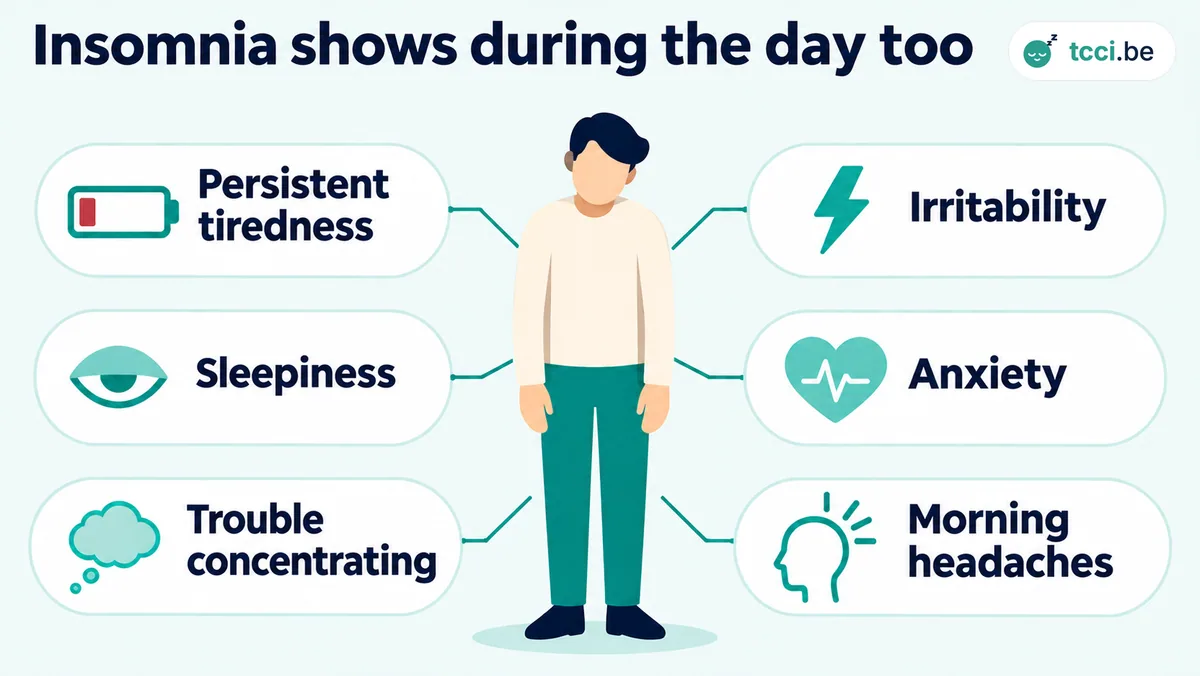
Insomnia does not stop when morning comes. Its effects during the day are often what makes people seek help:
Tiredness
- Deep fatigue that rest does not relieve
- Excessive sleepiness during the day
- 10% of road accidents in Belgium
- Not enough energy for everyday tasks
Thinking and memory
- Difficulty concentrating and paying attention
- Weaker working memory
- Slower reaction times
- Difficulty making decisions
Emotional impact
- Irritability out of all proportion
- More anxiety
- Low mood
- Withdrawing from others and coping less well with stress
Physical impact
- Headaches in the morning
- Muscle tension and digestive problems
- A weakened immune system
- Higher risk of high blood pressure in the long run
Acute or chronic insomnia: the difference that matters
Not all insomnia is the same. How long it lasts and how often it happens make all the difference to how it is treated.
Acute insomnia
- Linked to an identifiable event (an exam, a bereavement, moving house, jet lag)
- Often clears up on its own once the source of stress goes away
- Does not usually need any specific treatment
Chronic insomnia
- Sleep problems on at least 3 nights a week
- Despite having the right conditions to sleep
- With a measurable impact on your days
It is chronic insomnia that needs treatment. And the recommended first-line treatment is not a sleeping pill: it is CBT-I.
Pseudo-insomnia: when you think you sleep badly
An important concept: pseudo-insomnia (also called sleep state misperception). You are convinced you only sleep 3 or 4 hours, but objective measurements (polysomnography) show that you sleep 6 or 7 hours.
How can you tell? If you feel fine during the day despite the impression that you sleep badly, your sleep is probably sufficient. Real insomnia is judged over the full 24 hours, not just the night.
Take stock now
Recognise several of these symptoms? Two simple steps to get an objective picture of where you stand:
Step 1
Take the ISI test
7 questions, 3 minutes, an instant result with a clinical score. The reference tool for measuring how severe your insomnia is.
Take the testStep 2
Keep a sleep diary
For 2 weeks, note when you go to bed, when you get up and when you wake in the night. A simple, powerful way to see your sleep objectively.
See the sleep diaryIf your ISI score is above 14 or your symptoms have lasted more than 3 months, seeing a CBT-I therapist is recommended.
The solution
Insomnia can be treated, without medication.
CBT-I (cognitive behavioural therapy for insomnia) is the recommended first-line treatment. More than 60% of patients see a significant and lasting improvement in their sleep in 6 to 8 sessions.
Frequently asked questions
Recognise these symptoms? CBT-I can help
CBT-I (cognitive behavioural therapy for insomnia) works on the mechanisms that keep your symptoms going. It takes 6 to 8 sessions, without medication: 41% of patients are in long-term remission, compared with 28% on sleeping pills (Furukawa, 2024).
Was this page useful?