CBT-I
Sleep hygiene: the rules that really make a difference
Caffeine, alcohol, blue light, temperature, exercise: the rules of sleep hygiene explained by the science, with the mechanisms, the amounts and the common mistakes. And why, on their own, they are not enough to beat chronic insomnia.
Key points
- Sleep hygiene on its own is not enough for chronic insomnia: it is the foundation, not the treatment.
- Get up at the same time every day, weekends included: it is the most powerful lever you have.
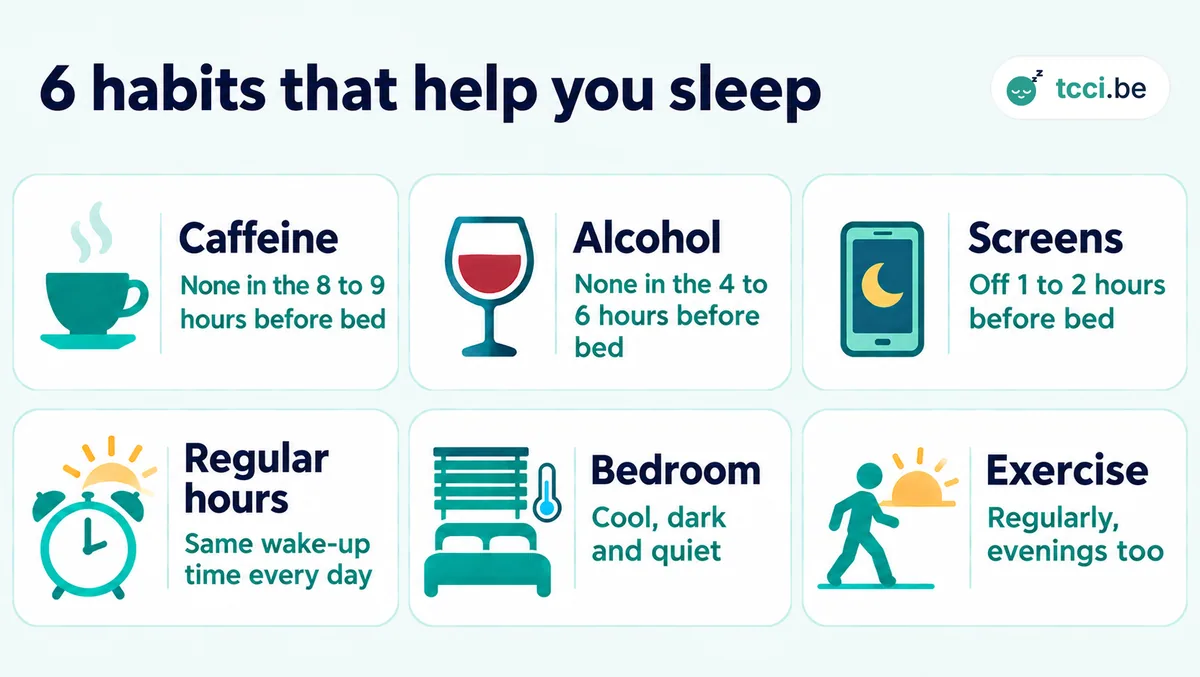
- No caffeine in the 8 to 9 hours before bed, no alcohol in the last 4 to 6 hours, no screens for the last 1 to 2 hours.
Important: proven not to work on its own
Sleep hygiene on its own is ineffective against chronic insomnia (iOR 1.01, statistically no better than a placebo, JAMA Psychiatry 2024). It is an essential foundation, but it really must be combined with CBT-I (sleep restriction, stimulus control and cognitive restructuring) to tackle the deeper mechanisms of insomnia.
Sleep hygiene is a bit like a balanced diet: everyone knows the broad principles, but few people really follow them. And as with diet, some rules make a real difference, while others are frankly overrated.
Strikingly, people with insomnia who know the rules of sleep hygiene actually follow them less closely than good sleepers do. Knowing is not enough.
Caffeine
At least 8 to 9 hours before bedThe half-life people underestimate
- A half-life of 3 to 5 hours: a coffee at 5 pm is still working at 8-10 pm.
- Blood levels peak 15 to 45 minutes after you drink it.
- The dose matters: an energy drink or a pre-workout (about 200 mg) means stopping at least 13 hours before bed.
- Hidden sources: black and green tea, chocolate, cola, energy drinks, some medicines.
Rule: no coffee in the 8 to 9 hours before bed: within that window, a cup still shortens your night (Gardiner, Sleep Med Rev 2023). If you go to bed at 11 pm, that means no coffee after 2 pm.
Alcohol
Reduces REM sleepThe enemy disguised as a friend
- It helps you fall asleep, but breaks up your sleep in the second half of the night.
- As your body processes it, rebound effects kick in: light sleep, waking up, sweating.
- It significantly reduces REM (dream) sleep, which is essential for consolidating memories.
- Even 1-2 glasses with dinner are enough to disrupt the night.
Rule: avoid alcohol in the 4 to 6 hours before bed. Never combine alcohol with sleeping pills.
Screens & light
Stop 1-2 hours before bedA double hit: light + stimulation
- Blue light suppresses melatonin, even at low intensity.
- What you are looking at (social media, the news) keeps your mind on alert.
- Mental stimulation often does more harm than the light itself.
- Blackout blinds or an eye mask to make the bedroom completely dark.
Rule: switch off screens 1 to 2 hours before bed. Keep the lighting dim in the evening.
Regular hours
Fixed wake-up time, 7 days a weekKeeping your body clock in sync
- An irregular schedule throws your circadian rhythm out of sync.
- Long lie-ins at the weekend shift your body clock and make Monday morning worse.
- Avoid naps (or, if you have insomnia, keep them to 10-15 minutes before 1 pm).
- A fixed wake-up time is the cornerstone of CBT-I: it anchors your circadian rhythm.
Rule: get up at the same time every day, weekends included. It is the most powerful lever you have.
Bedroom environment
Neither too hot nor too coldTemperature, noise, darkness, bedding
- There is no single ideal temperature. In older adults monitored at home, sleep was most efficient between 20 and 25°C and clearly worse above 25°C (Baniassadi 2023).
- A room that is too hot brings more awakenings and less deep sleep; cold is offset by your duvet and nightwear (Okamoto-Mizuno 2012).
- Tip: a warm bath 1-2 hours before bed speeds up the drop in body temperature.
- Noise: earplugs or white noise if you have insomnia and are sensitive to sound.
- Bedding: personal comfort comes first. Light sheets if you wake up sweating.
Rule: a cool, dark, quiet bedroom. Keep the bed for sleep only.
Exercise
Evenings too, except hard exercise right before bedGood for you, but timing matters
- Regular exercise increases the proportion of deep sleep.
- How it works: your body temperature rises, then the drop that follows tells your body it is time to sleep.
- Exercising in the evening does not harm sleep in healthy people, if anything the opposite (Stutz, Sports Med 2019).
- The one exception: hard exercise that ends less than an hour before bed can delay sleep and shorten the night.
Rule: move regularly, at whatever time suits you, evenings included. Finish any hard exercise at least an hour before bed.
What people often overrate
Blue light on its own
The mental impact of what you are watching (worrying news, social media, games) matters at least as much as the light itself.
Sleep teas
Their effect is real but modest. They work mainly through the ritual they create, not through their active ingredients.
The short nap
Good for someone who sleeps well. For someone with insomnia, even 15 minutes can release sleep pressure and make the following night harder.
Where sleep hygiene fits in CBT-I
In CBT-I, sleep hygiene is the foundation, not the treatment. It prepares the ground, but it is not enough to break the vicious circle of chronic insomnia.
1
Sleep hygiene
The starting point. Removes the surface factors that make insomnia worse.
2
Restriction + stimulus control
Works on the deeper behavioural mechanisms. Rebuilds sleep pressure.
3
Cognitive restructuring
Changes the beliefs and catastrophic thoughts that keep insomnia going.
Key figure: in the 2024 JAMA Psychiatry meta-analysis, sleep hygiene on its own has an iOR of 1.01 (ineffective). Full CBT-I reaches an iOR of 1.83 when delivered one to one. It is the combination of the three pillars that makes the difference.
Frequently asked questions
Was this page useful?
Scientific sources
- Furukawa Y, et al. Components of cognitive behavioral therapy for insomnia. JAMA Psychiatry. 2024;81(4):357-365.
- Morin CM, Buysse DJ. Management of Insomnia. NEJM. 2024;391(3):247-258.
- Gardiner C, et al. The effect of caffeine on subsequent sleep: a systematic review and meta-analysis. Sleep Med Rev. 2023;69:101764.
- Gardiner C, et al. The effect of alcohol on subsequent sleep in healthy adults. Sleep Med Rev. 2025;80:102030.
- Haghayegh S, et al. Before-bedtime passive body heating by warm shower or bath to improve sleep. Sleep Med Rev. 2019;46:124-135.
- West KE, et al. Blue light from LEDs elicits a dose-dependent suppression of melatonin. J Appl Physiol. 2011;110(3):619-626.
- Edinger JD, et al. Behavioral treatments for chronic insomnia disorder in adults: AASM guideline. JCSM. 2021;17(2):255-262.
- Stutz J, Eiholzer R, Spengler CM. Effects of evening exercise on sleep in healthy participants: a systematic review and meta-analysis. Sports Med. 2019;49(2):269-287.
- Okamoto-Mizuno K, Mizuno K. Effects of thermal environment on sleep and circadian rhythm. J Physiol Anthropol. 2012;31:14.
- Baniassadi A, et al. Nighttime ambient temperature and sleep in community-dwelling older adults. Sci Total Environ. 2023;899:165623.