CBT-I
What is CBT-I?
Cognitive behavioural therapy for insomnia (CBT-I) treats chronic insomnia without medication in 6 to 8 sessions, using sleep restriction, stimulus control and cognitive restructuring. More than 60% of patients see a significant and lasting improvement.
Key points
- 6 to 8 sessions, one to one, in a group or online.
- It works on the learned habits that keep insomnia going, not just on the symptom.
- The benefits last after the programme ends.
Chronic insomnia: a mechanism, not a life sentence
Chronic insomnia affects around 10 to 15% of people in Belgium. All too often, the medical response is still a prescription for sleeping pills, which eases the symptoms but leaves the causes untouched.
CBT-I starts from a different observation: chronic insomnia is kept going by learned mechanisms. Unhelpful sleep habits, anxious thoughts, and a bed that the brain has come to link with being awake. These mechanisms can be changed, and that is exactly what CBT-I does.
41%
long-term remission with CBT-I
6-8
sessions are enough for lasting results
24 months
of benefits maintained after the end
0
risk of dependence or side effects
The two systems that regulate sleep
To understand insomnia, and why CBT-I works, it helps to know how sleep regulates itself. Two biological processes run side by side:
Homeostatic process (S)
The longer you are awake, the more adenosine builds up in the brain, creating a growing pressure to sleep. During sleep, this debt is gradually paid back.
In practice: an afternoon nap "spends" your sleep debt and makes it harder to fall asleep at night.
Circadian rhythm (C)
Your internal body clock runs the sleep-wake cycle over 24 hours: release of melatonin (sleep) and cortisol (wakefulness), body temperature...
In practice: an irregular sleep schedule throws this clock out of sync. That is why CBT-I sets a fixed wake-up time, 7 days a week.
The flip-flop switch
Moving from wakefulness to sleep is a sudden switch, like flipping a light switch. Wake and sleep networks in the brain inhibit each other. There is no point trying to sleep when you do not feel sleepy: CBT-I creates the conditions for the switch to happen naturally.
Where CBT-I comes from
CBT-I was developed in the 1970s and 1980s by pioneers such as Dr Arthur Spielman (the 3P model) and Dr Charles Morin (standardised clinical protocols). It draws on decades of research in neuroscience and behavioural therapy.
Recommended as the first-line treatment by:
- American Academy of Sleep Medicine (AASM)
- European Sleep Research Society (ESRS)
- Haute Autorité de Santé (HAS, France)
- NICE (United Kingdom)
The 3 pillars of CBT-I
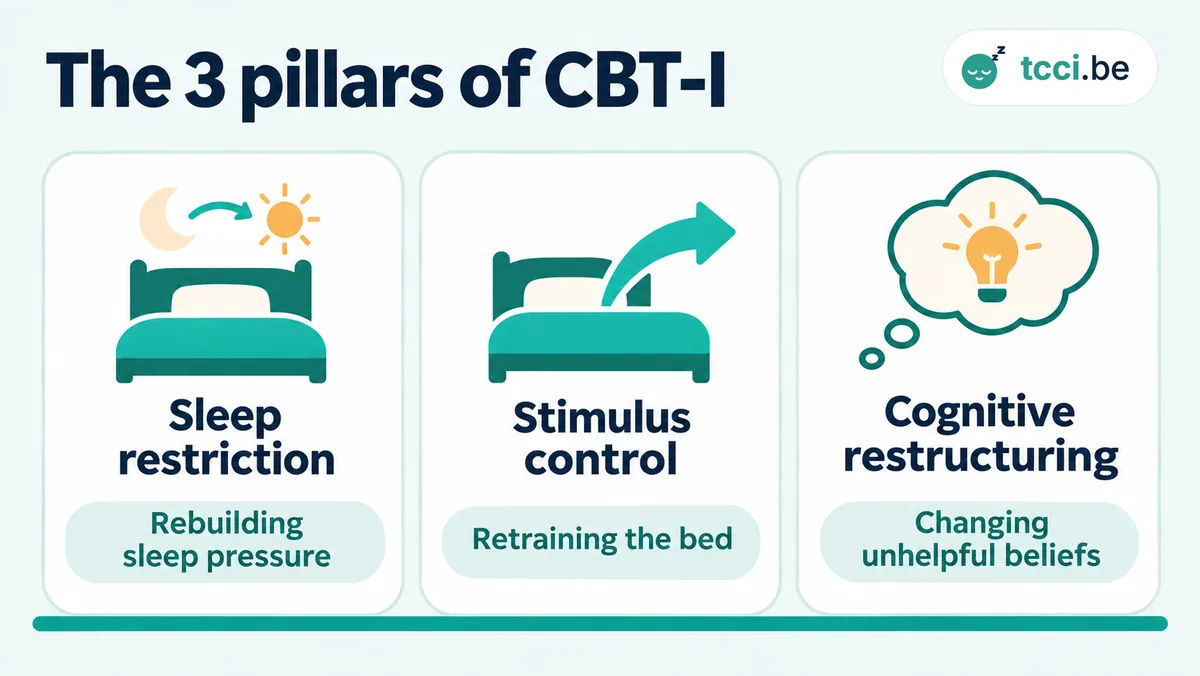
1. Sleep restriction
iOR: 1.49Rebuilding sleep pressure
If you sleep 5 hours but spend 9 hours in bed, your sleep is spread thin and broken up. Sleep restriction brings your time in bed down to 5 hours, creating a mild sleep debt that helps you fall asleep faster, sleep more continuously and sleep more deeply. Week by week, the window is extended once your sleep efficiency is above 85%.
2. Stimulus control
iOR: 1.43Retraining the bed
After many nights lying awake and ruminating, the brain links the bed with being awake. Stimulus control rebuilds the link between bed and sleep: go to bed only when you feel sleepy, get up if you have not fallen asleep within 15-20 minutes, and keep the bed for sleep only.
3. Cognitive restructuring
iOR: 1.68, the most effectiveChanging unhelpful beliefs
Insomnia comes with catastrophic thoughts: "I'll never sleep", "I'm going to fall apart". These thoughts raise performance anxiety and keep you awake. Cognitive restructuring helps you spot these beliefs and replace them with more accurate ones.
Did you know?
According to a 2024 meta-analysis in JAMA Psychiatry, sleep hygiene on its own is ineffective (iOR: 1.01) and relaxation on its own is possibly counterproductive (iOR: 0.81). The strength of CBT-I comes from combining the 3 pillars.
Why CBT-I outperforms sleeping pills
| Criterion | Sleeping pills | CBT-I |
|---|---|---|
| Short-term effect | Fast | Gradual (2-4 weeks) |
| Long-term effect | Wears off | Lasting (24+ months) |
| Remission rate | 28% | 41% (Furukawa 2024) |
| Risk of dependence | High | None |
| Side effects | Memory, falls | None |
| Relapse after stopping | Common | Rare |
| Sleep quality | Artificial | Natural sleep restored |
Sources: Morin & Buysse, NEJM 2024 · Furukawa et al., PCN 2024 · Perlis et al., Lancet 2022
How a CBT-I programme runs
01
Full assessment
A review of your sleep, an explanation of the cognitive behavioural model, and starting the sleep diary. Setting realistic goals.
02
Sleep restriction + stimulus control
Introducing the two main behavioural techniques. Adjusting the sleep window based on the diary.
03
Cognitive work
Identifying and reframing unhelpful beliefs about sleep. Sleep hygiene.
04
Consolidation
Handling setbacks, relaxation techniques, relapse prevention. A long-term maintenance plan.
CBT-I one to one, in a group or online
One to one
Personalised follow-up, with the protocol finely tuned to you. Best suited to complex cases.
iOR: 1.83, the most effective
In a group
Slightly less effective, but still significantly so, and often cheaper. You benefit from the group dynamic (6-8 people).
Online
Available anywhere, with proven effectiveness for straightforward cases. A good option if no therapist is available.
Frequently asked questions
Was this page useful?
Scientific sources
- Morin CM, Buysse DJ. Management of Insomnia. NEJM. 2024;391(3):247-258.
- Perlis ML, et al. Insomnia. Lancet. 2022;400:1047-1060.
- Furukawa Y, et al. Components of CBT-I. JAMA Psychiatry. 2024;81(4):357-365.
- Furukawa Y, et al. Initial treatment for chronic insomnia. PCN. 2024;78(11):646-653.